FRIDAY - Transforming Black-box Models into Transparent Assets
Client.
Standard Chatered Bank
Tools.
Figma
Year.
2023
Role.
Sr. Product Designer
Background
At Standard Chartered, AI and machine learning models are used to process sensitive financial documents such as passports and cheques to reduce manual banking operations. However, while AI reduced operational effort, the compliance process surrounding these models remained highly manual.
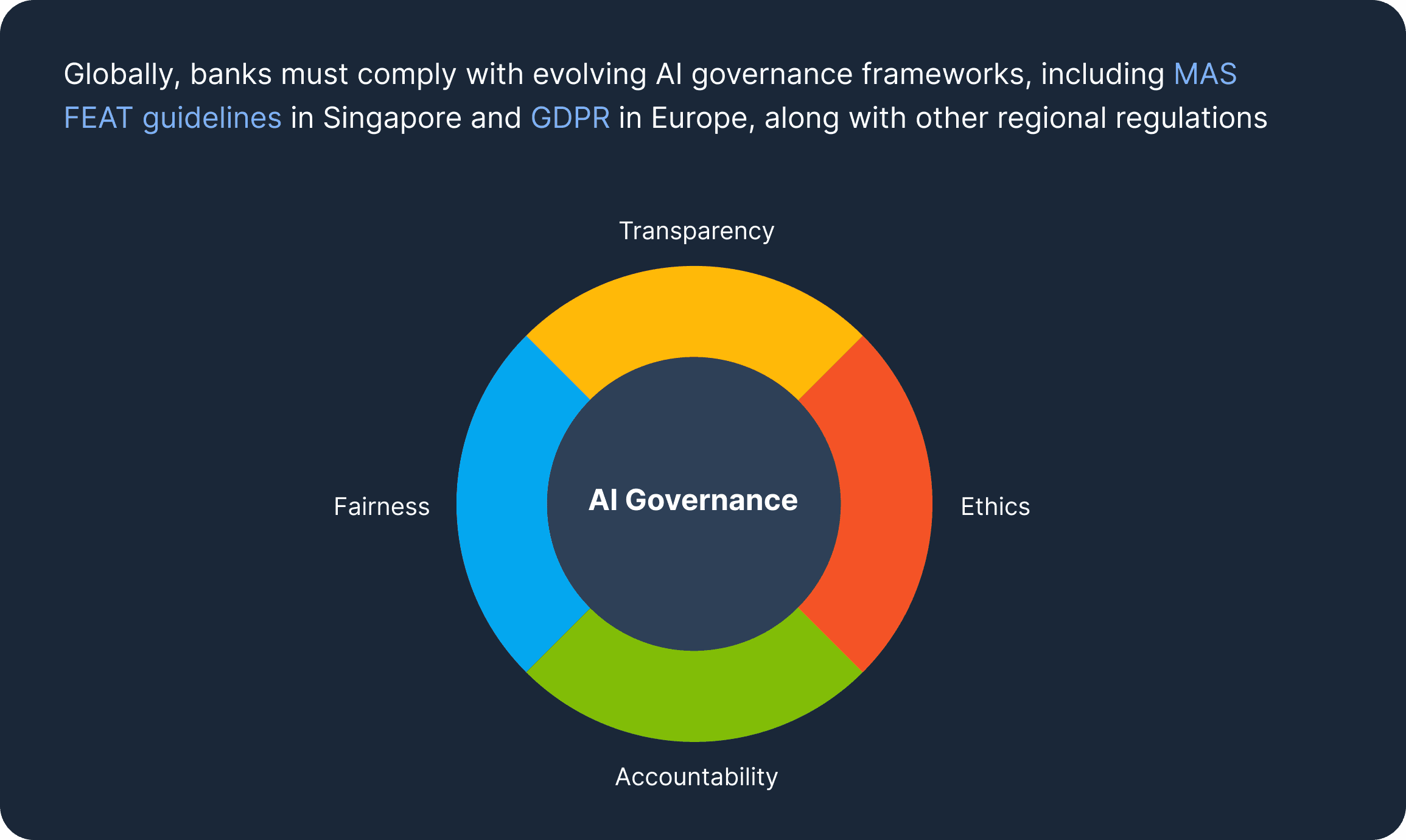
Because the bank operates across multiple regions, every model must comply with strict local and international regulatory guidelines related to privacy, fairness, transparency, and responsible AI usage. This meant teams spent significant time validating fairness, masking PII, preparing audit documentation, and coordinating approvals across departments.
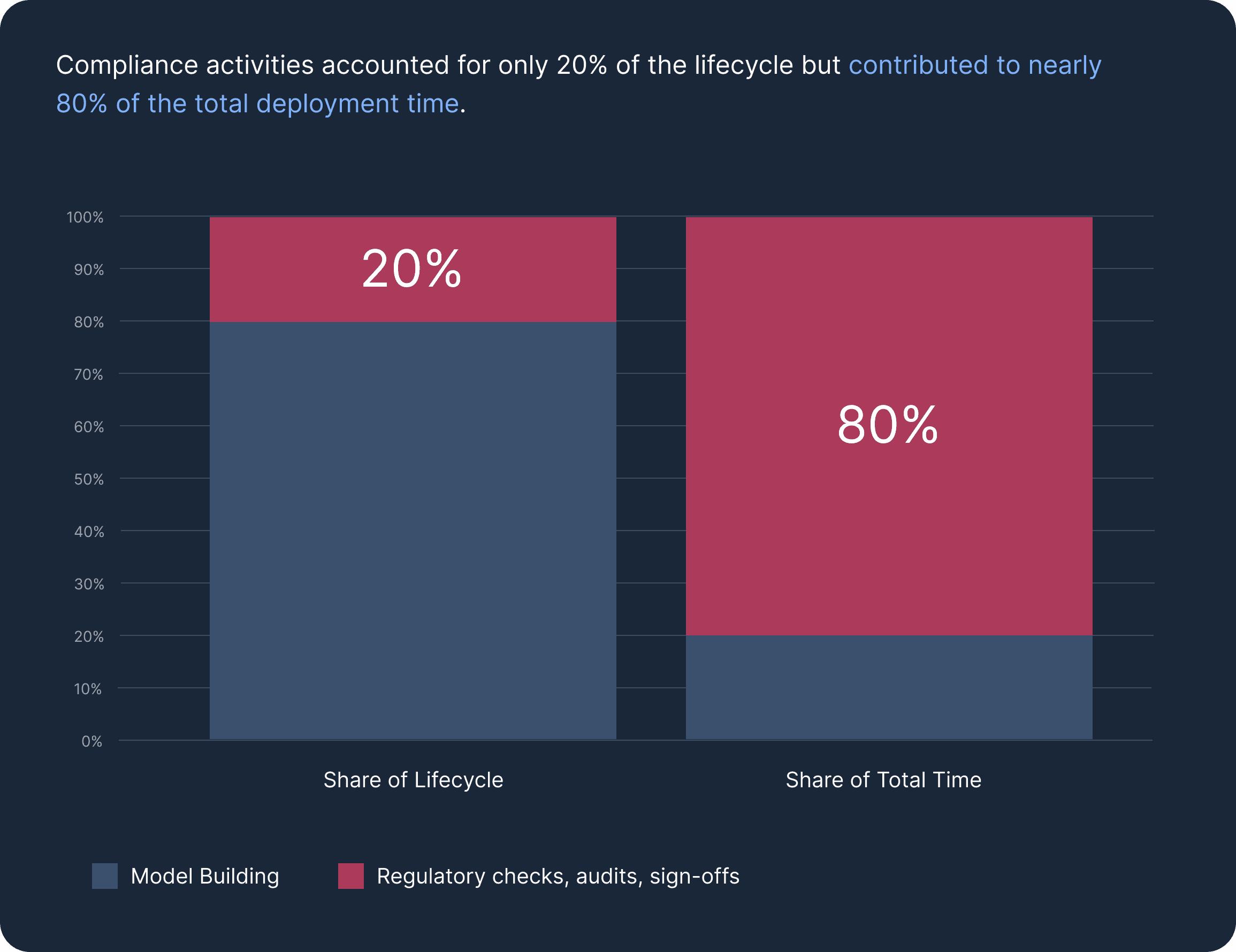
Although model training itself was relatively fast, compliance activities, which accounted for only about 20% of the overall AI/ML lifecycle, were consuming nearly 80% of the total deployment time. As a result, deploying a single AI/ML model could take anywhere between 6 to 9 months.
To address this, Standard Chartered developed FRIDAY (Framework Responsible for Intelligent Data and Algorithm Yield), a centralized AI-governance platform designed to make AI systems more transparent, auditable, and scalable.
My Role
I worked as the Lead Product Designer for FRIDAY and was involved from the BRD and SRS stages to ensure user needs and operational realities were embedded into the platform from the beginning.
Alongside defining the design strategy and collaborating with stakeholders, engineers, and compliance teams, I led the end-to-end design of the Data Suitability and Explainability engines. My responsibilities included workflow mapping, research synthesis, service blueprinting, design systems, and UI execution.
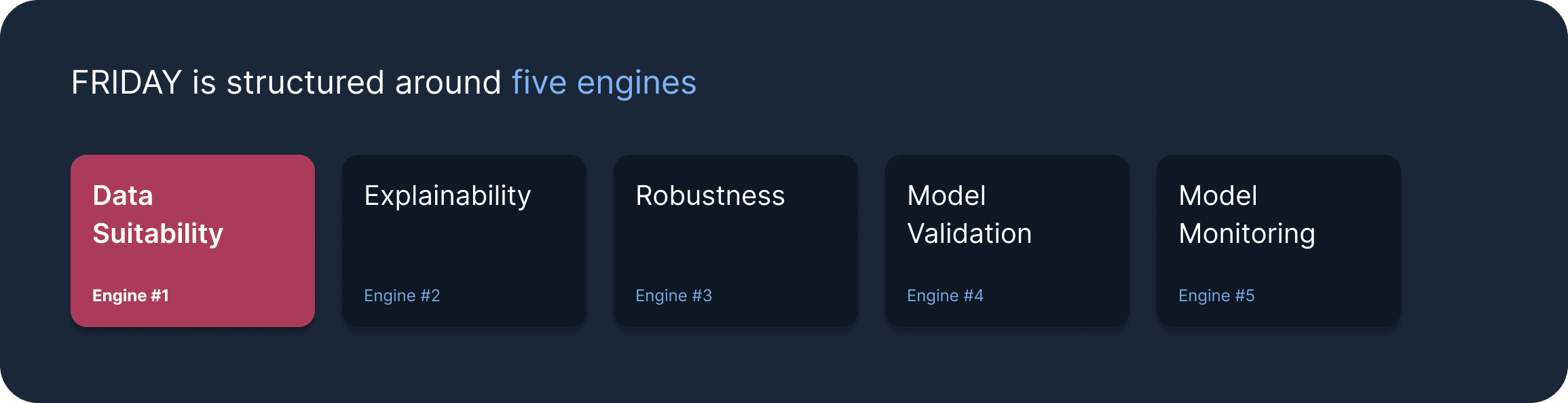
This case study focuses on the Data Suitability Engine
Problem
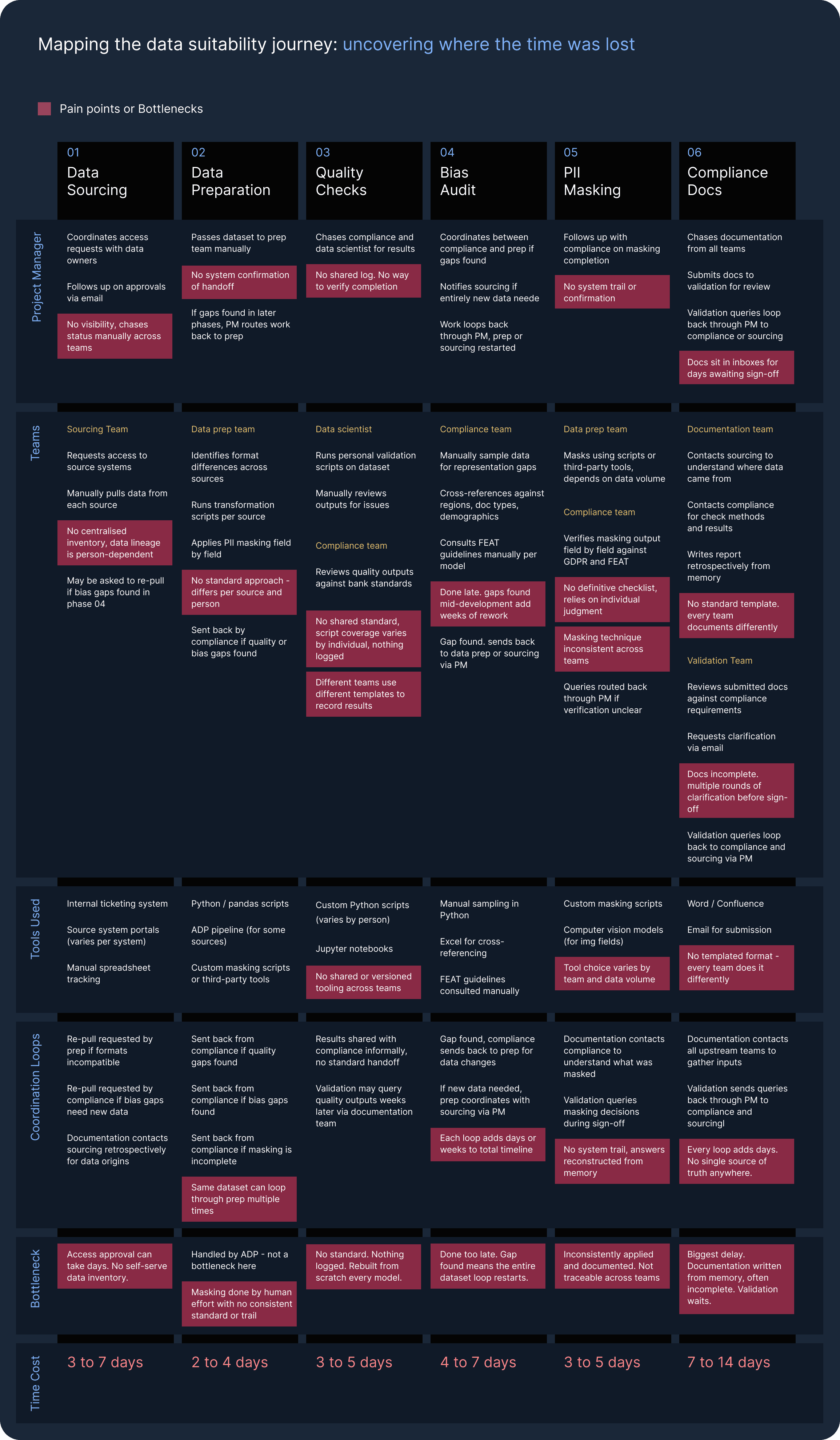
Before a model could be trained, its dataset had to go through multiple layers of validation for quality, fairness, privacy, and regulatory compliance. This process alone took 4–6 weeks per model. While Standard Chartered already knew that manual compliance was causing delays, we needed to deeply understand where and how these inefficiencies were impacting the overall deployment timeline.
To uncover this, I along with the Product Owner facilitated a collaborative workshop with cross-functional teams including compliance teams, validation teams, and project managers to better understand:
What the existing process looked like to ensure data suitability
How much time each stage was consuming
What the bottlenecks were in each phase
How teams coordinated and handed off work between each other
Core Insight
One unexpected insight from the workshop was that the delays were not just caused by manual compliance work, but by the heavy dependency on multiple teams working sequentially across the data suitability lifecycle.
The same dataset was repeatedly passed between sourcing, data preparation, compliance, validation, and documentation teams, creating constant back-and-forth coordination, repeated reviews, and duplicated effort because validations were difficult to trace and standardize across teams.
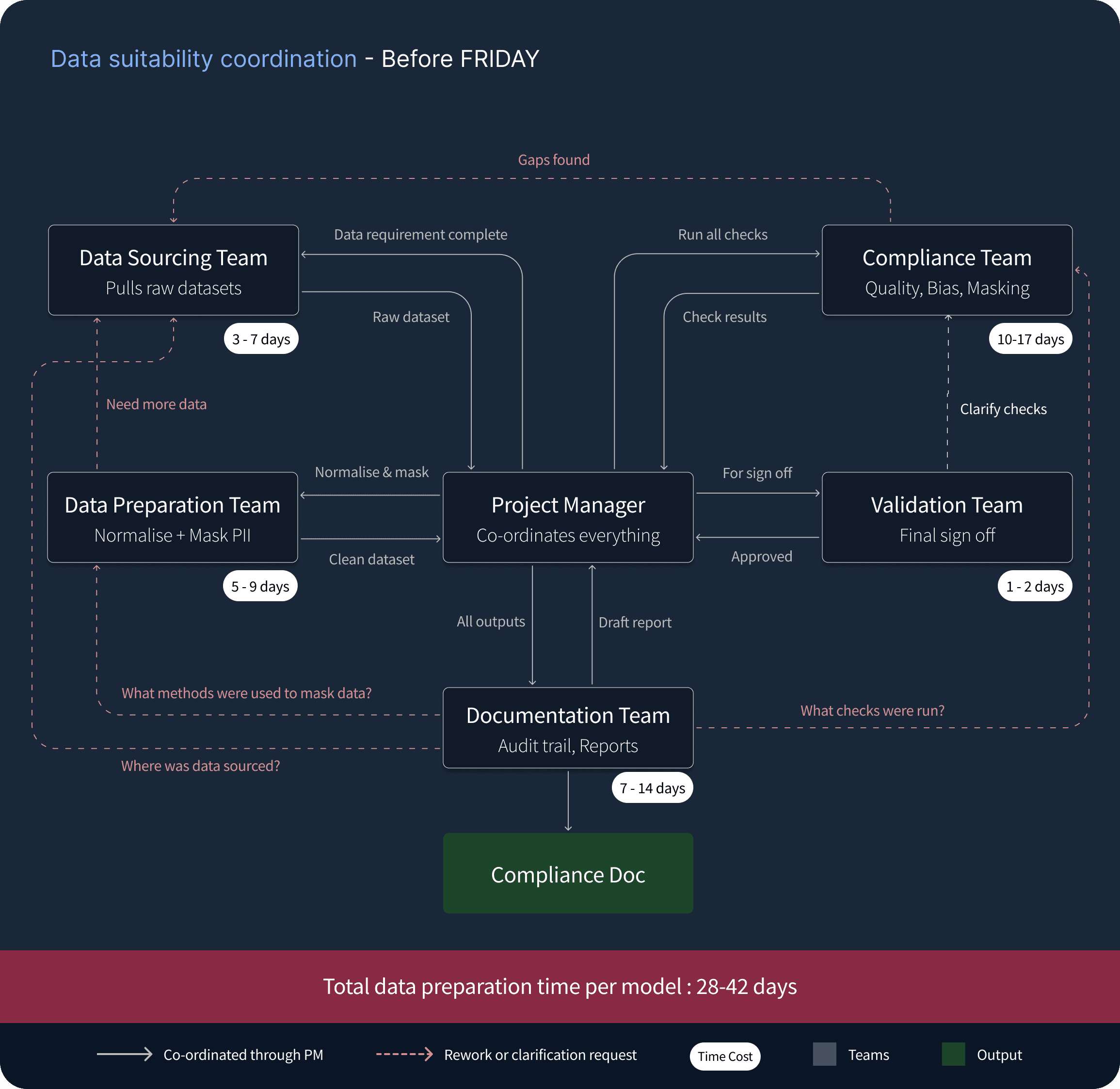
Key Insights
Fragmented workflows across teams and tools
Heavy manual coordination between teams
Repeated validation and rework
Late-stage bias and fairness checks
Manual audit documentation
Repetitive PII verification
Inconsistent validation approaches
Lack of centralized audit visibility
Poor traceability across the lifecycle
How Might We
How might we reduce compliance delays and operational complexity in the data suitability process across the AI/ML lifecycle??
Solution
The first step of the solution involved collaborating with compliance stakeholders, engineers, project managers, and architects to understand the operational workflow and identify opportunities for automation and standardization.
The workshops helped us uncover:
Which validations could be automated reliably
Which workflows needed standardization across teams
Which decisions still required human oversight
How to reduce dependency on multiple team handoffs
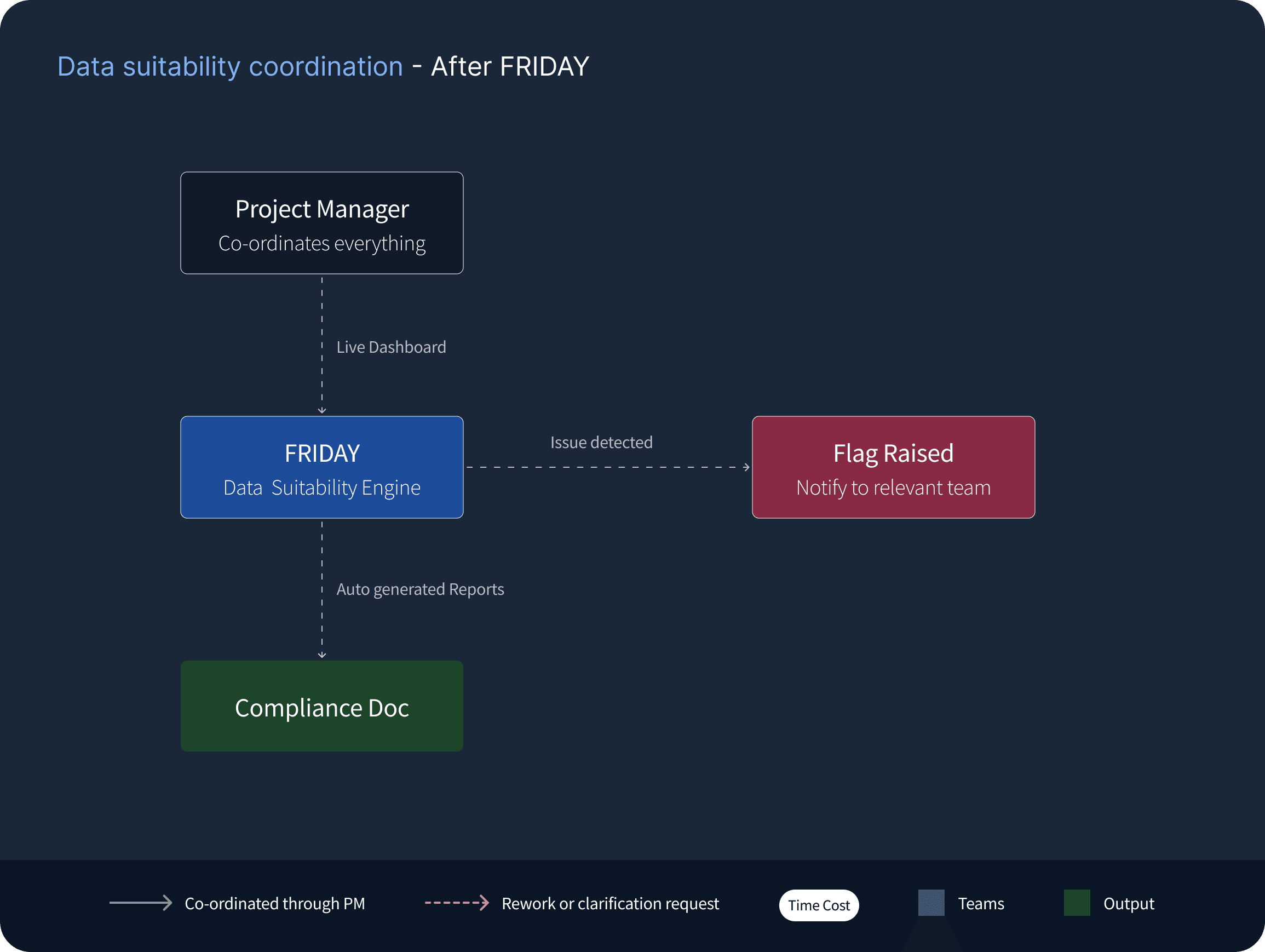
One of the key design decisions I proposed was shifting the workflow from a team-dependent process to a project manager-driven experience, where the project manager became the primary user overseeing the entire workflow instead of multiple teams working separately across sourcing, compliance, masking, validation, and documentation.
This significantly reduced delays because the workflow no longer depended on teams waiting on each other at every stage. As long as validations and compliance checks passed successfully, the project manager could independently move the workflow forward.
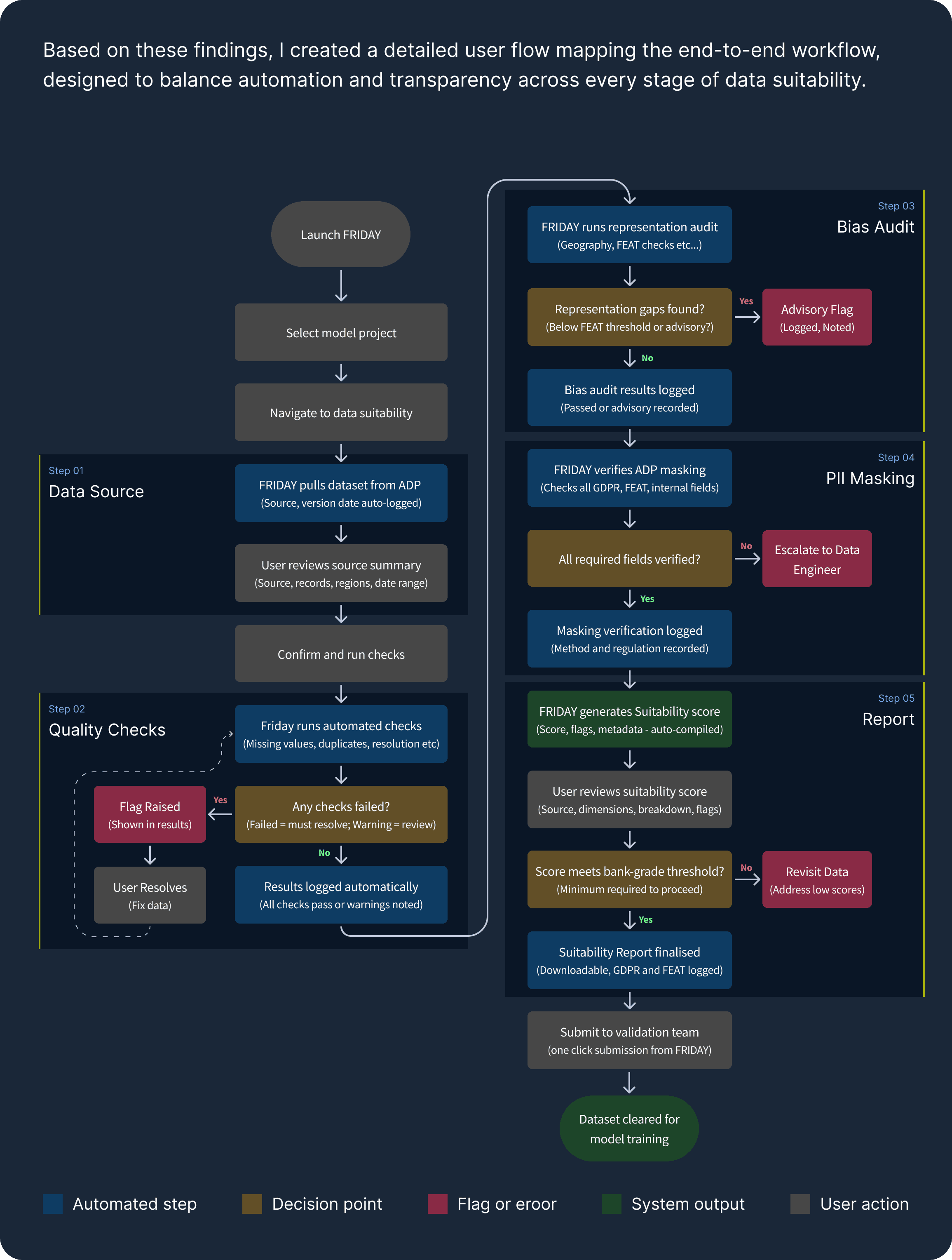
The experience was intentionally designed to simplify operational complexity. Complex validations were translated into clear statuses, warnings, recommendations, masking decisions, and audit visibility directly within the workflow so the project manager could easily understand the overall suitability status without requiring deep technical or compliance expertise.
If an issue required attention, the project manager could simply flag the step, automatically notifying the relevant teams responsible for resolution. This reduced constant back-and-forth coordination while still ensuring the right teams were involved only when necessary.
This led to the design of the Data Suitability Engine within FRIDAY, a centralized workflow structured into five connected stages:
Data source visibility and lineage
Standardized automated quality checks
Bias and representation audits
Guided PII masking and enforcement
Auto-generated suitability reporting
Each stage was designed to reduce repeated effort, improve traceability, and simplify operational complexity while maintaining regulatory rigor and audit readiness.
Step 1 - Data source visibility and lineage
One of the first challenges teams faced was the lack of visibility into dataset origins, ownership, and extraction history. Validation teams often depended on manual coordination across systems, making the process difficult to trace and audit.
As the designer, I created a centralized experience that surfaced lineage, ownership, extraction history, regional distribution, and dataset composition in one place. I also collaborated with engineers to automate audit logs and lineage tracking, improving traceability and reducing manual coordination.

Solution impact: Improved audit visibility and reduced cross-team dependency
Time saved: Eliminated manual data inventory tracking
Step 2 - Standardised automated quality checks
Validation teams were using different scripts and validation approaches to review dataset quality, leading to inconsistent outcomes and repeated reviews.
I designed a standardized validation workflow that translated technical outputs into clear statuses, warnings, thresholds, and recommended actions. I also helped structure how automated validation results were grouped and prioritized to make reviews faster and more consistent across teams.

Solution impact: Standardized quality validation across teams
Time saved: Reduced days of manual validation work to automated checks completed within minutes
Step 3 - Bias and representation audit
Bias validation was often performed at different stages of the lifecycle, resulting in repeated suitability reviews and downstream compliance delays.
I designed an early-stage bias audit experience that surfaced representation gaps, fairness indicators, compliance warnings, and corrective recommendations directly within the workflow. This helped teams identify risks earlier and review fairness more consistently across projects.

Solution impact: Improved consistency in fairness validation
Time saved: Reduced repeated rework during compliance reviews
Step 4 - Guided PII masking with enforcement
Different teams applied different masking techniques for similar types of sensitive data, creating inconsistencies in privacy validation and audit reviews.
I designed a guided masking workflow that standardized how masking decisions were reviewed and documented. The experience clearly surfaced masking techniques, regulatory references, field-level decisions, and masking status within a single workflow.

Solution impact: Improved standardization and traceability in PII validation
Time saved: Reduced repetitive field-level verification and documentation effort
Step 5 - Auto-generated suitability report
Audit preparation required teams to manually consolidate validation outputs, compliance records, and masking decisions from multiple systems.
I designed a system-driven reporting experience that automatically generated a centralized Suitability Report using workflow data. I structured the report hierarchy and review flow to help stakeholders quickly understand dataset risks, compliance status, and audit history.

Solution impact: Reduced compliance documentation effort and improved audit readiness
Time saved: Reduced audit preparation from weeks of manual effort to minutes
Impact
FRIDAY transformed the final compliance stage of the AI/ML lifecycle from a fragmented manual process into a scalable and audit-ready system.
Measurable Impact
Model deployment timelines reduced from 6–9 months to under 30 days (projected)
Data suitability validation reduced from 4–6 weeks to a few hours (projected)
Addressed nearly 80% of deployment delays by optimizing the final compliance stage
Reduced compliance documentation effort from weeks to minutes
Improved standardization, traceability, and regulatory readiness across teams